




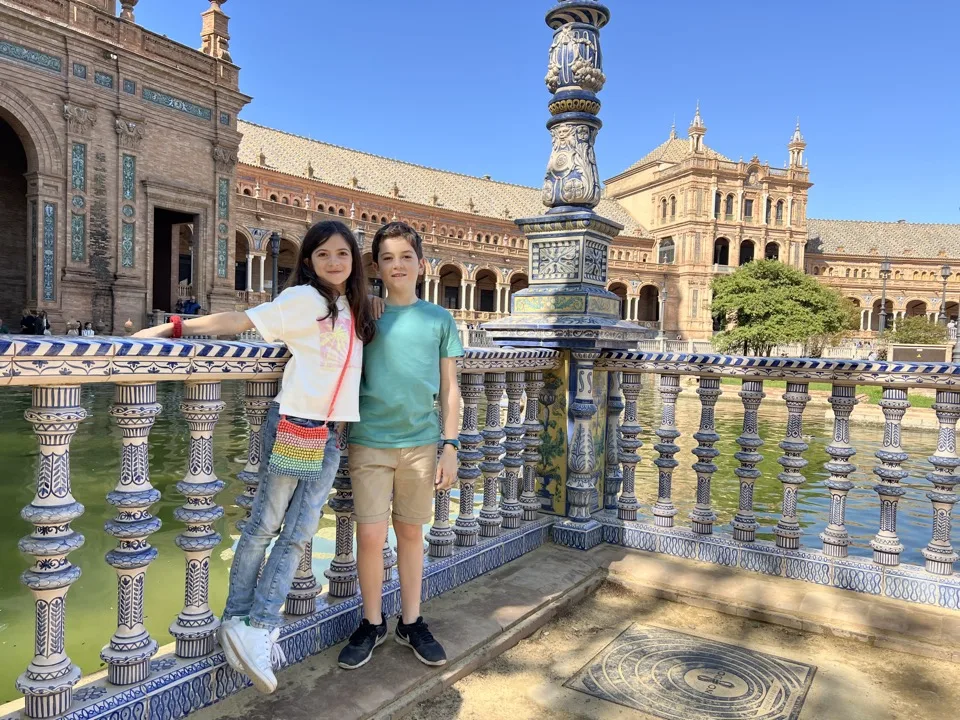
During the Easter holidays, we spent a day in Cambridge. I had wanted to discover this famous university city for a long time. Only Papa Voyage had been there before, when he was a student; for the children and me, it was our first visit. We all loved Cambridge! It is a very pleasant little city: peaceful and beautiful. We were also lucky enough to have bright sunshine almost all day. Our Cambridge day trip was a real favourite, and we explored everything on foot from morning until evening.

Here is our itinerary and programme for visiting Cambridge:
We began our long walk at Castle Mound, having parked in Shire Hall Car park, which proved to be a good choice. It is a small outdoor car park about a 15-minute walk from the city centre. Current prices vary according to the length and day of your stay, so check the latest tariff before visiting.
Discovering the colleges of the University of Cambridge
The University of Cambridge consists of 31 colleges, some more prestigious and famous than others. We first walked from college to college along the gardens known as The Backs, so called because they lie behind the colleges. We followed the River Cam, which separates the university buildings from the public parkland. Walking beside the Cam is truly delightful.
We did not see all the colleges, but in order we passed Westminster College, St John’s College from a distance and Trinity College. Looping back through the city side, we then passed King’s College—the most famous—and Queens’ College. It is a wonderful way to admire the architecture associated with England’s historic universities. The colleges are not generally open to the public, although some offer paid visits, sometimes at a considerable price. We considered visiting Trinity College because it seemed good value, but the tours were fully booked. Perhaps we will visit all these colleges once Ticoeur and Titpuce are at sixth form and we can attend university open days ;-).
Tip: It is normally possible to attend a service featuring the choir at King’s College free of charge in the late afternoon. Check the chapel calendar because the choir and service schedule follows the university term. During our visit in the holidays, there was no choir because the students had gone home.


Visiting Trinity College’s Wren Library
While visiting Trinity College itself is chargeable, admission to the Wren Library is free. Perfect! It was an ideal way to glimpse a small part of the university world. The library is normally open to visitors from noon to 2 pm on weekdays throughout the year, with additional Saturday opening from 10.30 am to 12.30 pm on selected term-time dates. Hours and closures can change, so check before setting off. Visitor numbers are controlled and you may need to queue, so arriving a little early is sensible.
What a beautiful and fascinating library! Its collections include very old medieval manuscripts, books and notes associated with Isaac Newton, who studied at Trinity, and original Winnie-the-Pooh manuscripts by A. A. Milne, another former Trinity student. The architecture is magnificent: when the Wren Library was completed at the end of the 17th century, it was the largest library in England. Photography rules may vary, so follow the instructions displayed during your visit.

Walking beside the River Cam
I mentioned it above, but this really is one of the loveliest things to do in Cambridge: walking alongside the River Cam, which is wonderfully picturesque with its weeping willows. We covered everything on foot, although some visitors choose to take a ride in a punt, the city’s traditional flat-bottomed boat. Rather like in Venice, a sort of English gondolier propels and steers it with a long pole. The activity is known as punting and can be rather expensive. A cheaper alternative is to hire a punt without a chauffeur, but it is best to be skilful: steering properly along the river does not look easy at all!


In short, we stayed on foot. It was more economical and perfect for taking our time and wandering. Along the way, you come across several pretty little bridges. The Mathematical Bridge is especially well known:

The lanes of Cambridge’s historic centre
Cambridge’s historic centre is full of charm. Despite being lively, it has a very pleasant and peaceful atmosphere. There are hardly any cars, which makes walking particularly enjoyable. Simply wandering through the lanes, passing Great St Mary’s Church, the market and the little passages makes for a lovely walk. The centre has numerous cafés, tearooms, shops and restaurants. Some of Cambridge’s most charming central streets include Trinity Street, Rose Crescent, Green Street and Laundress Lane.


At the corner of Trumpington Street and Bene’t Street, you will see the Corpus Clock, a large and very strange timepiece. We were not exactly charmed by the giant insect—a grasshopper—that tells the time. Its mechanism is apparently very complex. The effect feels rather like a chamber of horrors or haunted house: the time-eating grasshopper is striking because of its size, shine and movements. As an interesting detail, the Corpus Clock was unveiled by Stephen Hawking.

During our wander, we happened upon two Dinky Doors. These are miniature decorative doors—a form of street art, you might say. They are not essential sights, but it was fun to encounter two along our route: one very close to the entrance of Trinity College and another near the New Museums Site on Downing Street. You can buy a map showing all Cambridge’s Dinky Doors, although we were not interested enough to do so.


Visiting the Fitzwilliam Museum
This is Cambridge’s principal museum and admission is free. It is rather like Oxford’s Ashmolean Museum, although smaller. In other words, it contains a little of everything: Egyptian, Asian and Middle Eastern collections, as well as paintings, including several works by Turner, a room devoted to Impressionism and a Picasso. The advantage is that you can see a varied selection in a little over an hour without boring or tiring the children.


Visiting Kettle’s Yard
We finished by visiting the Kettle’s Yard art gallery, right beside our car park. The temporary exhibition, which was free, was rather sombre because its theme was Syria. In addition to the small exhibition area, you can visit the private collection in Jim and Helen Ede’s former home. Admission to the house is chargeable for most adults, while temporary exhibitions remain free; see the latest information on the Kettle’s Yard website. It is a place worth visiting for lovers of modern and contemporary art. The museum shop may be small, but it had many lovely reproductions.
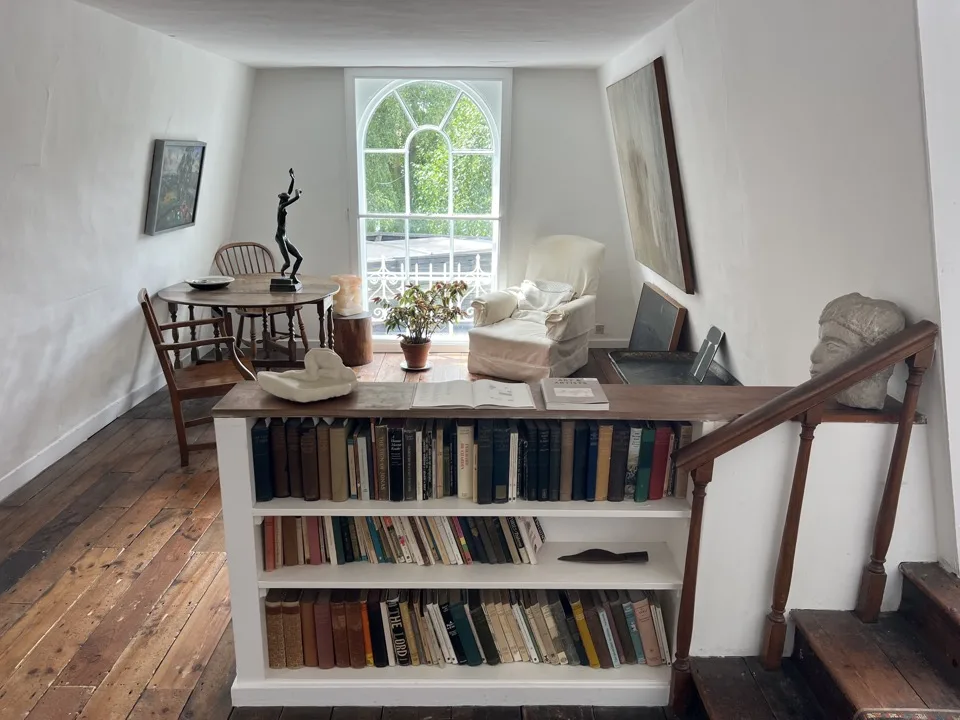
We returned to the car park after climbing the little mound beside it:

Where to eat in Cambridge
Aromi: a Sicilian café where we had lunch. It offers a wide selection of pizza by the slice. It was good and inexpensive, and the coffee was excellent too—which is rare in England!


Oriental Café: we loved this little restaurant serving homemade dumplings. The premises look unassuming and are on a rather unattractive street outside the historic centre, but the food was delicious and very reasonably priced. The owners were also absolutely lovely, and their cucumber salad was delicious too!

Where can families stay in Cambridge?
We stayed at the Novotel Cambridge North, about a ten-minute drive from central Cambridge. It was convenient for us because we had a car. Without one, reaching the historic centre is less direct: buses may be infrequent and the train takes you to Cambridge station rather than right into the centre. However, the room price was attractive compared with accommodation in historic Cambridge. The children were also delighted to have a swimming pool, which was very good. If you know the Novotel chain, you will be familiar with its family rooms, which have a double bed and a sofa bed for the children. Children’s buffet breakfasts are free. In short, it was comfortable and the best value we found: very comfortable beds, friendly staff, a gym, pool and sauna. I should add that I booked at the last minute. With more forward planning, you may find a charming place in the historic part of the city.
How do you get to Cambridge?
Direct trains from London King’s Cross take about an hour, making Cambridge possible as a day trip if you set off early. By car, it is roughly 1 hour 20 minutes north of London, two hours from Dover and around two hours from Oxford, depending on traffic. For us, Cambridge was a stop after visiting Bletchley Park, where the Enigma code was broken—I will tell you more about it soon. After Cambridge, we travelled on to explore the Norfolk coast; I will also write about that road trip.
Cambridge or Oxford?
Both cities are clearly worth visiting for their architecture and universities. Oxford is also particularly worthwhile for its museums. You can read my article about Oxford with children. Personally, I preferred Cambridge because I found it more charming. It really is a very pretty, green city, and I could easily have imagined studying there!

And you? Would you like to visit Cambridge?
Also worth reading
 Visiting Bristol: street art and discoveriesA mother-daughter day in Bristol: street art, walks and visits
 Christmas in London: 20 family activitiesPlanning Christmas in London with children? Discover 20 family-friendly ideas, festive lights, shows, attractions and practical…
 Our one-week Cornwall road-tripOur family holiday in Cornwall: Nos vacances en famille en Cornouailles : dream coves, vanlife and wild coast
 Where to stay in London? 7 ideas to chose your neighbourhoodChose your accommodation in London with kids or as a couple: our guide by neighbourhood
 3 days in Edinburgh with my teenagerA long mother-daughter weekend in Edinburgh: Harry Potter, art, history and shopping in the Scottish capital
 7 family hikes in MallorcaOur 7 hikes as a family in Mallorca during the autumn term-break

You read this blog — which means you value quality content grounded in real experiences. With Google Preferred Sources, tell Google which publishers you trust. Add us and other sources you love, and Google will surface them more in your future search results.