


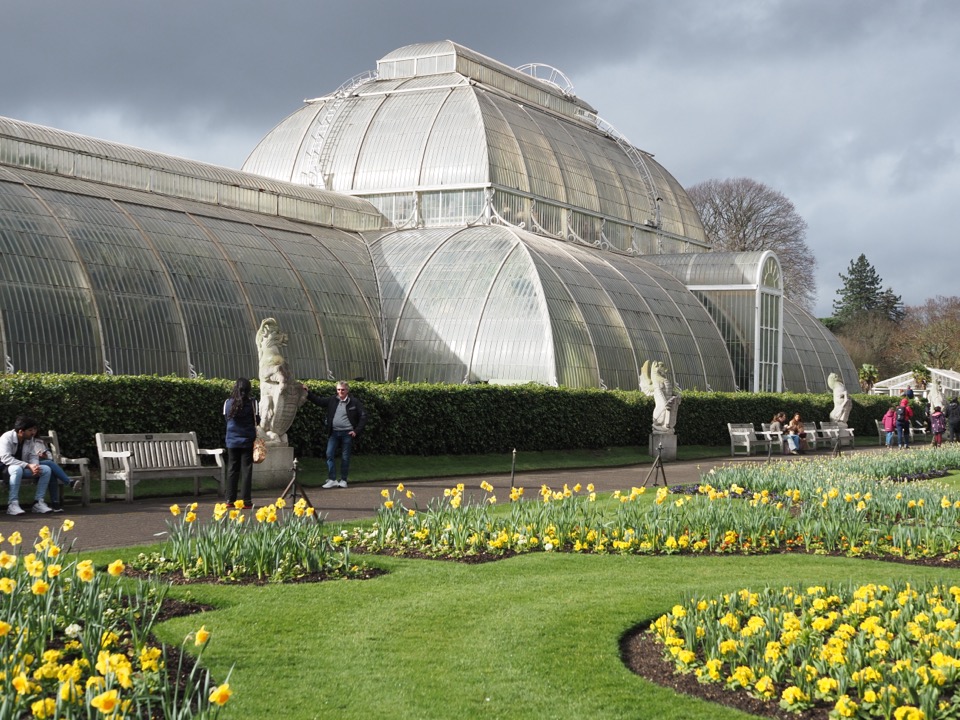
Is it possible to visit Kew Gardens in half a day? Yes, we tested and approved it! Between the large glasshouses, the different gardens, the viewpoints and the “monuments” of Kew Gardens, it’s absolutely possible to enjoy a very lovely first visit in just a few hours, without feeling like you’re rushing. I’d say you need to allow 3 to 4 hours to discover London’s magnificent botanical garden, a UNESCO World Heritage Site.
To do that, it’s best to focus on the key attractions at Kew Gardens. In this article, I’m suggesting a simple route to discover the most impressive spots in the gardens. The idea isn’t to tick everything off, but to see what makes Kew unique: its iconic glasshouses, elegant avenues, immersive spaces and landmark spots.
If you’re visiting London for only a few days, you probably won’t have more than half a day to dedicate to Kew Gardens. I’d even say that Kew Gardens will only be part of your London programme if this isn’t your first stay in London. I visited London many times before going to Kew Gardens, but this visit was enchanting – a green interlude, very different from central London. Since then, we’ve been back to Kew Gardens other times, as a family. In fact, we’ve just spent our Sunday afternoon there for the Orchid Festival, which I’ll tell you about further down.
Here are the main key attractions at Kew Gardens to see if you only have half a day.
Kew Gardens: our key attractions in half a day
The tropical glasshouse: Palm House
This is Kew Gardens’ best-known glasshouse. It’s a magnificent tropical glasshouse dating from the Victorian era. Inside, you’ll find huge palm trees and tropical plants, notably from Madagascar, as well as coffee plants, cacao trees, oil palms and rubber trees. Architecturally, the glasshouse has lovely Victorian spiral staircases, as well as a walkway that lets you admire the plants from above. Note: the Palm House will close for major works from 2027, for 5 years!


And in this photo of the upper section, you can see why the renovation is necessary 🙂

The temperate glasshouse: Temperate House
This is the largest glasshouse at Kew Gardens and even the largest Victorian glasshouse in the world. It was renovated a few years ago, so it’s very beautiful, very bright and very spacious. You’ll find many species from Mediterranean climates in Europe, Oceania, South Africa, etc. Notably worth seeing: the gigantic Chilean palm and some beautiful giant ferns. There’s also a lovely staircase and an upper gallery.


The Chinese pagoda
This is a symbol of Kew Gardens. 80 carved dragons decorate its tiers. You can climb it from April to September for a panoramic view.

The Japanese garden
Small but very charming. It’s a peaceful haven not far from the pagoda. A sort of “Asia corner”, then! You’ll see a carved Japanese gate (a replica of a temple gate), a stone path, mini waterfalls, streams, tea plants and cherry trees (in bloom in April). There’s a bamboo garden right next door.

The winter garden
A space to discover in winter, to see a few flowers and plants that bring colour to the grey days!

These pretty shrubs with yellow flowers called “paper bushes” come from Japan. They smell lovely! Like jasmine, I think. This plant is used in Japan to make quality paper and banknotes!


The treetop walk: Treetop Walkaway
Another well-known structure at Kew Gardens. The Treetop Walkway is 18 metres high, so you shouldn’t be afraid of heights! It offers different viewpoints over Kew Gardens and it amuses children. Best avoided if you have vertigo.

The art installation: The Hive
This work by artist Wolfgang Buttress was created for the 2015 Milan World Expo. As its name suggests, this installation represents a beehive. The structure is complex and fascinating. You can go inside for an immersive experience. Loudspeakers play the buzzing of bees. It really feels like you’re there! The aim is to raise awareness of the importance of bees for the planet. When art meets science!


The Princess of Wales Conservatory: cacti and orchids
In this glasshouse, you’ll find a collection of cacti, orchids and even carnivorous plants! It’s interesting, but this glasshouse is even more unmissable during the Orchid Festival, which we went to last weekend (see below).

The Orchid Festival
The Orchid Festival takes place every year at Kew Gardens between early February and early March. In 2026, it’s the 30th edition of this festival. It was the first time we’d been. It’s busy, but it’s worth it: you wander for 30 minutes through the Princess of Wales Conservatory, discovering a multitude of orchid varieties. The festival highlights the diversity of this flower but also offers a real feast for the eyes, with majestic floral arrangements. This year, the theme is China, so there was a giant dragon decorated in orchids! At the end of the route, an informative film teaches us about all the work carried out at Kew Gardens to help conserve orchids and reintroduce them into the wild in England. Until 8 March 2026.
Entry to the festival is included in the admission ticket, but you absolutely must book a timed slot several days or weeks in advance (see practical information further down).


The Waterlily House is closed until April 2027:
This glasshouse is right next to the Palm House.
 Photo of water lilies taken during our previous visit, before the closure
***
Our suggested half-day itinerary in Kew Gardens
3.5-hour itinerary in Kew Gardens:
This is an itinerary we tested as a family last weekend. It took us 3.5 hours. You could do it the other way round or create your own route depending on your priorities! I’ve highlighted seasonal tips in purple.
- Enter via Victoria Gate.
- Visit the tropical glasshouse, the Palm House, entering via the south door.
- Exit via the west door. In summer, you’ll find yourself facing lots of roses. Also, from this exit, you’ll see the grand avenues: the main avenue (Syon Vista) that leads to the Thames and the diagonal avenue (Pagoda Vista) that leads to the Pagoda. On the avenue next to the Pagoda, you can enjoy the cherry blossoms in April.
- Visit the Temperate House.
- In winter, take a detour via the winter garden.
- Then continue towards the Pagoda and the Japanese garden.
- Loop back via the Treetop Walkway for a walk up high.
- Head back, continuing to enjoy the trees in the arboretum, towards The Hive.
- Finish with the Princess of Wales Conservatory for the cacti and orchids. Note: during the Orchid Festival, early February to early March, you need to book a timed slot to enter the conservatory. We recommend scheduling this slot at the start or end of your half day (we chose the end) because this conservatory isn’t far from the exit. Allow 30 minutes to do the orchid trail during the festival.
- You exit via the Kew Gardens shop: a place full of temptations! You’ll find lovely gift ideas and plants. We fell for… an orchid!

Just to add that when the children were younger, we spent 5 hours in Kew Gardens because with young children there are fun trails not to be missed and playgrounds!
Other areas that might interest you if you have more time:
- The small bonsai glasshouse (not too far from the exit):

- The arboretum: we pass through part of it on our route, but the arboretum covers 2/3 of the gardens with no fewer than 2,000 tree species! You’ll also come across rhododendrons in April–May.
- Walk along the Great Broad Walk Borders: a long planted avenue between the tropical glasshouse and the orangery. You’ll see lots of daffodils in early spring and a wide variety of flowers from June to September.
- The botanical painting exhibition in the Marianne North Gallery.
- The Davies Alpine House for alpine plants
- The Carbon Garden, a mushroom-shaped installation. You’ll see it from afar in any case.
Practical information for visiting Kew Gardens:
Transport from London:
- By Tube: take the District Line and get off at Kew Gardens. Allow 25 minutes by Tube from “South Kensington” station and about 45 minutes from central London.
- By car: there’s parking for £9 per day (in 2026), but if you come on a Sunday, there are streets where parking is free. See parkopedia.com to find them.
Opening times and booking
For all information on opening times, prices and online booking (it’s cheaper than on the spot!), head to the official Kew Gardens website.
When to visit Kew Gardens?
All seasons have their charm! And whatever the time of year, you’ll always enjoy the glasshouses. Here are the highlights by season:
- Autumn: we really liked this period for the warm colours of the trees. There were still roses on the flower side.
- Winter: this is when there’s the least going on, so in that case, we recommend combining it with the Orchid Festival, which takes place in February–March.
- Spring: unsurprisingly, it’s the best period for flowers! Including magnolias and rhododendrons. In April, there are even cherry blossoms (sakura).
- Summer: the rose garden is particularly beautiful in summer, as are the water lilies.
 Kew Gardens in autumn
A foodie spot near Kew Gardens:
Before going into Kew Gardens, we bought delicious savoury pastries and cakes from Sift Bakes & Brews in Richmond (open 8am to 4.30pm Tuesday to Sunday). It’s a 10-minute walk from the entrance to Kew Gardens, but it’s worth making the detour from the Tube! The blueberry banana cake is excellent! Note that picnicking is allowed in the park.

Accommodation in London
I wrote an article suggesting accommodation in London by neighbourhood. To be well located both for visiting central London and for going to Kew Gardens, take a particularly close look at my advice for the South Kensignton neighbourhood.
***
Who’s planning to visit Kew Gardens soon?